Fault-tolerant quantum architecture · The Baker Group · 2026
Chameleon
Calibration-aware optimization of per-qubit Clifford frames for spatially non-uniform biased noise.
Overview
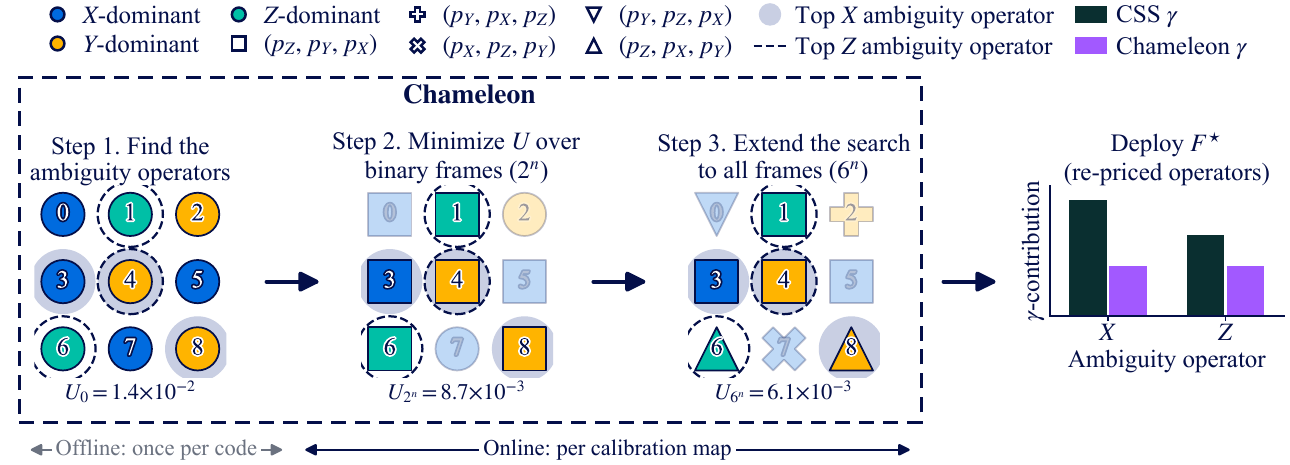
Superconducting devices exhibit qubit-dependent Pauli error rates and spatially non-uniform X/Z bias. Chameleon treats Clifford deformation as a compile-time selection of local Pauli frames, so a code can adapt to each calibration map without adding qubits, syndrome-extraction rounds, or code-distance cost.
A logical failure can arise from two same-syndrome error patterns with different logical effects. Their product is an ambiguity operator. Chameleon changes the per-qubit frame to reduce the probability mass of these decoder-unavoidable, Type-A failure mechanisms.
Design
Reusable Ambiguity-Set Construction
Collect low-weight ambiguity operators once per code and store the retained set in a lookup table that is reused across calibration maps.
Binary-Frame Search with an Analytic Bound
Replace exponential rare-event evaluation with a decoder-free Bhattacharyya upper bound, then minimize the surrogate U over the binary frame space {I, H}ⁿ.
Refinement to the Full Frame Space
Warm-start a cross-entropy search over all six rate-distinct Clifford frames and deploy the refined frame only when it improves the objective.
Key results
Across calibration-derived noise maps, Chameleon reduces average worst-axis Type-A logical error rates by 13%, 7%, and 4% for surface, color, and bivariate-bicycle codes relative to the best prior baseline.
Frame-selection times exclude one-time ambiguity-set construction. The days-to-minutes comparison uses 75,000 candidates and an idealized 1 μs-per-shot decoder baseline (v1, Table III).
People
-
 Won Joon Yun
-

-